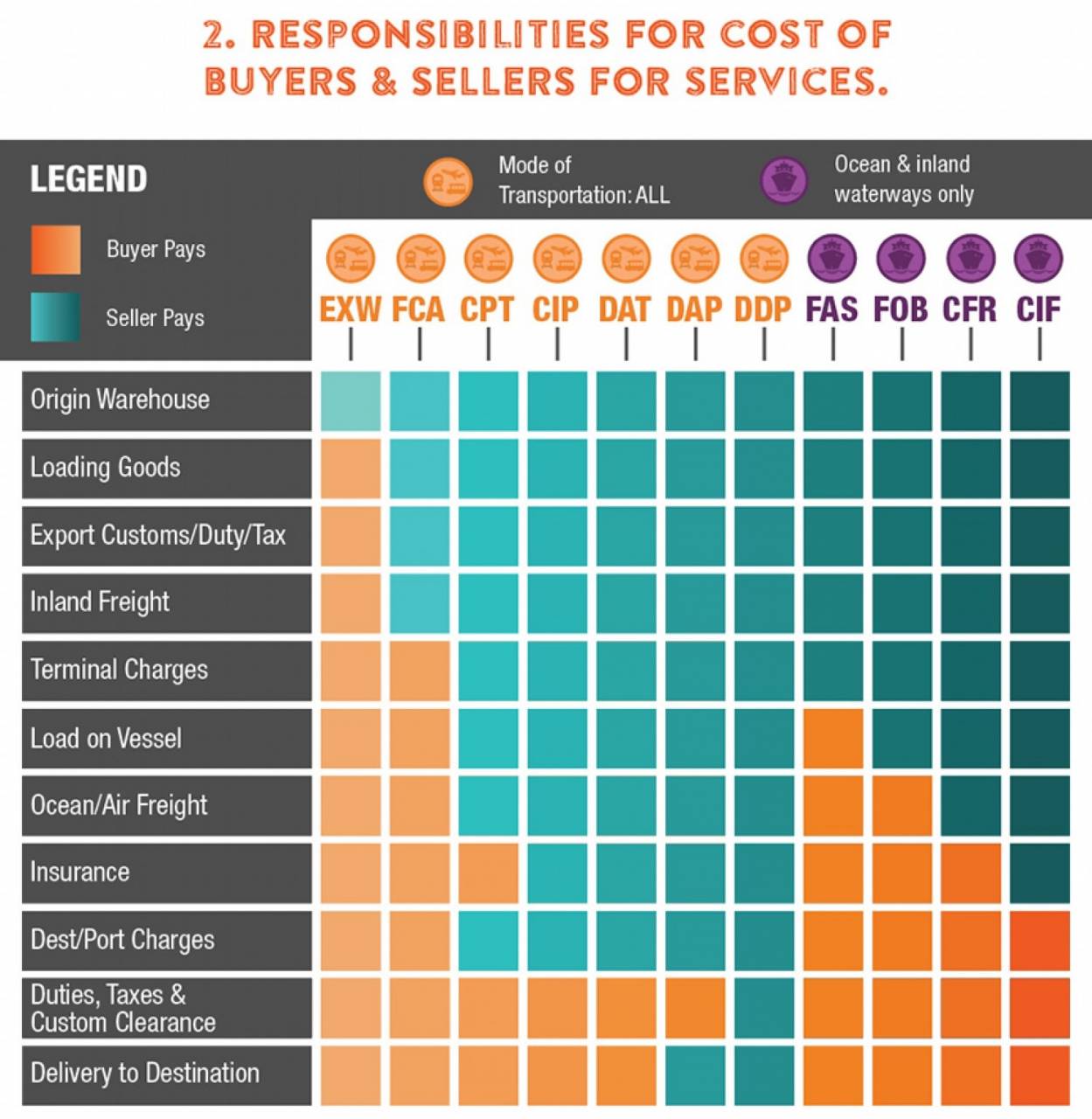
Incoterms are a standard set of terminology, created by the International Chamber of Commerce (ICC), used universally, defining the key parts of freight forwarding. In 1936 the ICC first defined the International Commerce Terminology (INCO Terms), and we have summarized the 11 most commonly used terms below. Incoterms is a registered trademark of the International Chamber of Commerce.
Rules for all modes of transport
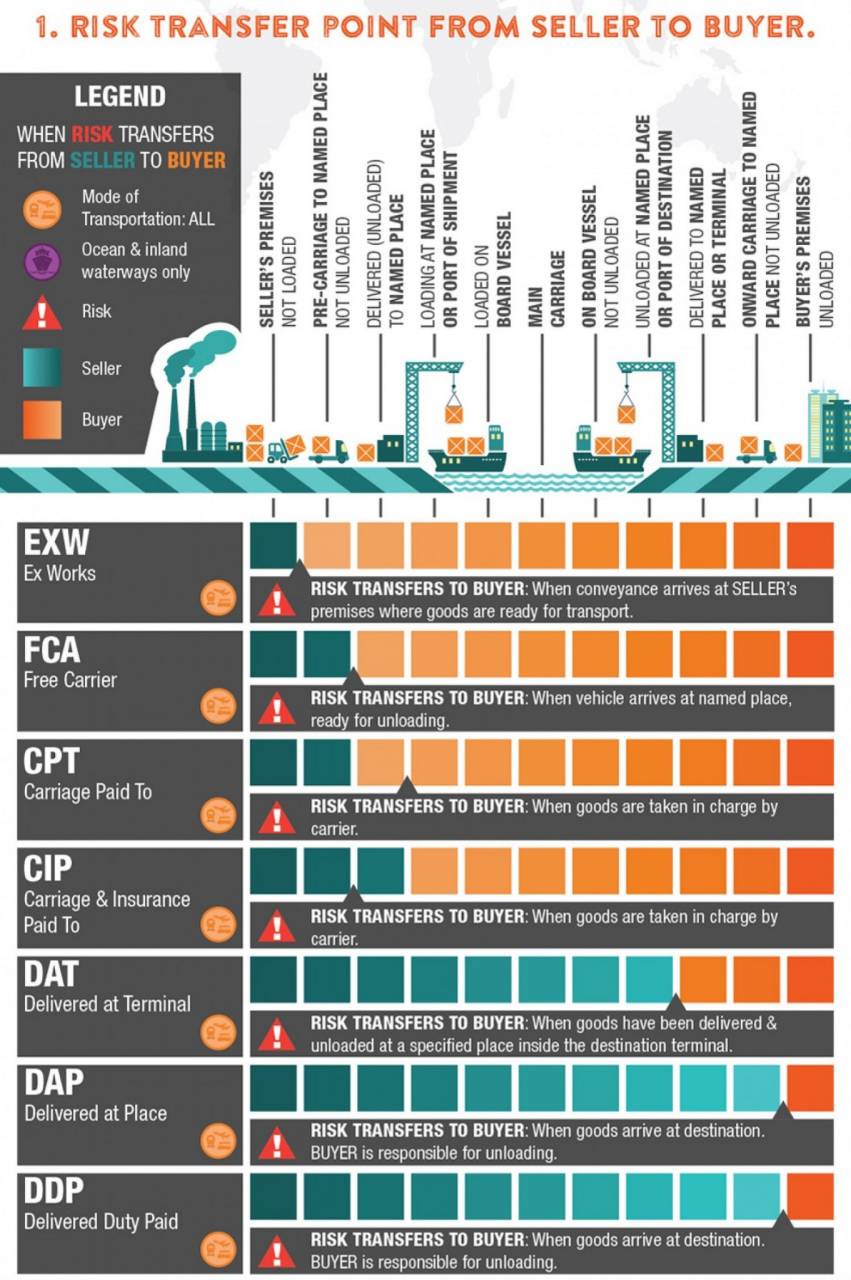
EWW - Ex Works
Ex Works (EXW) is the term used to describe the
delivery of goods to an available designation at their
place of business, normally in their factory, offices or
warehouse.
The seller does not need to then load items onto a
truck or ship, and the remainder of the shipment is the
responsibility of the buyer (e.g. overseas shipment and
customs duty). EXW is therefore more favorable to
the seller as they do not need to worry about the
freight once it has left their premises.
FCA - Free Carrier
Unlike EXW, Free Carrier pushes the responsibility of
delivering the goods to the buyers nominated
premises onto the seller, so they have to organise
shipping and various export documents.
CPT - Carriage Paid To
“Carriage Paid To”, or CPT, goes into a little more
detail than FCA, specifying that the seller bears the
costs for transporting the goods to the nominated
place that the buyer requests.
CIP - Carriage and Insurance Paid to
“Carriage and Insurance Paid to”, or CPI, specifies
that the seller needs to pay the costs of transport as
well as the insurance cover for the goods in transit (by
any transport mode) to the destination named by the
buyer.
DDP - Delivered Duty Paid
“Delivered Duty Paid”, or DPP, can be used for any
mode of transport. In this case, the seller is responsible
for delivering the goods at a place specified by the
buyer, up to the point of unloading. Unlike DAP rules,
the seller is also required to pay for all Duties and
Taxes, clear the goods for import and pay relevant
taxes.
DPP is often complex as shipment of goods into a
market are often best left to local experts (e.g. the in market
buyer), so it’s a less commonly used INCOTerm.
DAT - Delivery at Terminal
“Delivered at Terminal”, or DAT, means that all of the
costs up until the point of delivery to a nominated
terminal (e.g. a port or a quay) need to be covered.
As in the table above, the buyer would need to
arrange Duties and Taxes and clearing goods through
customs. With DAT, the seller is also responsible for
unloading the goods at the terminal.
It’s advisable to ensure the terminal, hub or port is
clearly specified, given the size of many terminals.
DAP - Delivered at Place
“Delivered at Place”, or DAP, can also be used for any
mode of transport. An extension of DAT, the seller
delivers the goods at a named destination, specified
by the buyer, although under the ICC rules, the
unloading of the goods are the responsibility of the
buyer.
The buyer is also required to sort out duties and taxes,
as well as clearing the goods through customs.
Rules for Goods transported by sea or inland waterway
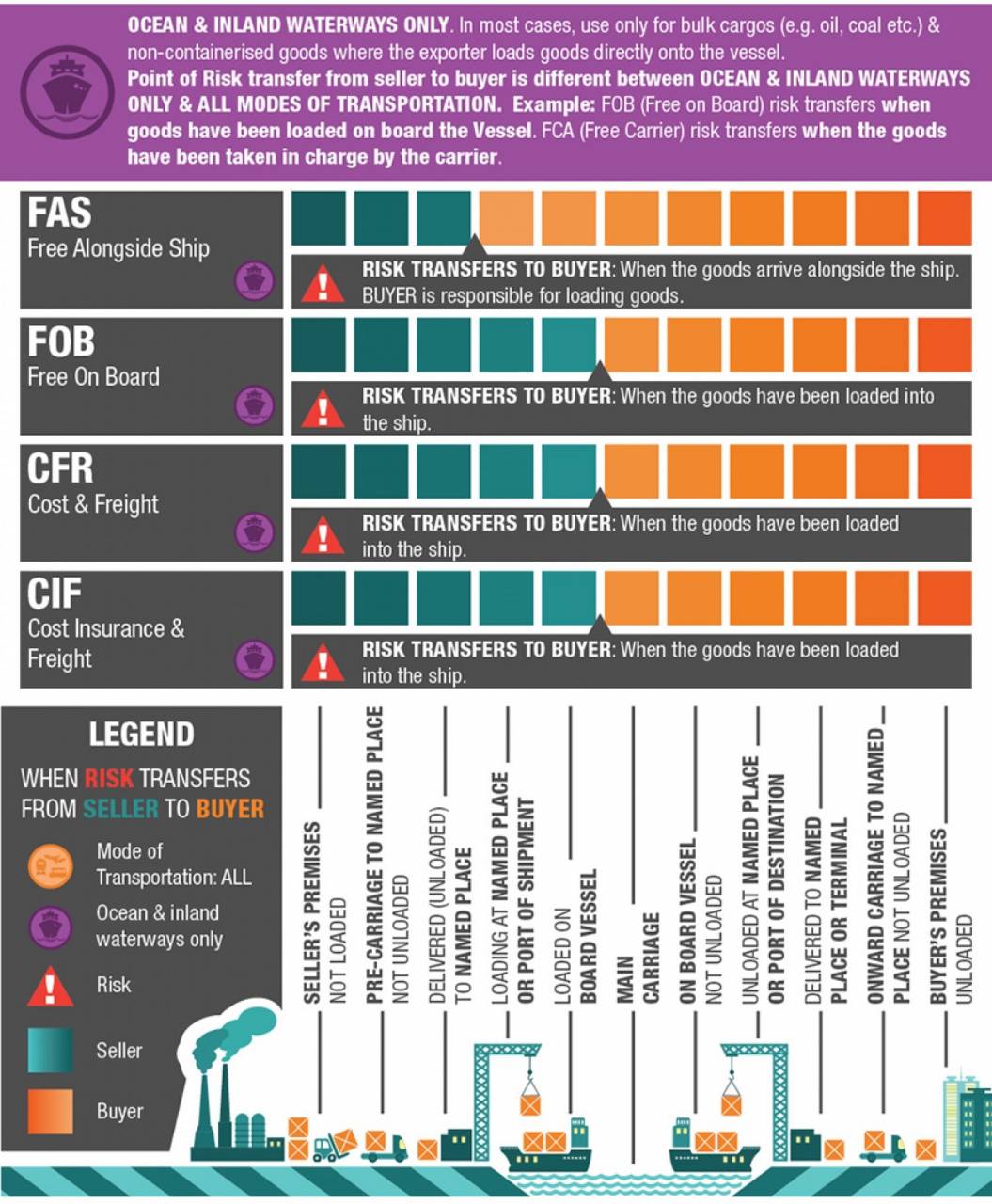
FAS - Free Alongside Ship
“Free Alongside Ship”, or FAS, is used in situations when
the seller can place the goods alongside other noncontainerised
goods (e.g. on a vessel or barge).
The seller might do this if they have access to sea or
inland waterway routes and want to place the goods
en route to the buyer alongside other goods on the
ship. It’s not recommended for goods that can be
placed in a container (more on this below, see FCA).
The risk of transporting the goods ‘alongside ship’
move from the seller to the buyer once the goods are
delivered to a terminal or port and unloaded.
FOB - Free On Board
“Free On Board”, or FOB, occurs when the seller
delivers the goods to the port of shipment, at which
then it becomes the responsibility of the buyer once
unloaded onto a vessel. If the goods are damaged
when on board the vessel, it’s the responsibility of the
buyer.
CFR - Cost and Freight
“Cost and Freight”, or CFR, incurs more risk and
responsibility onto the seller. The seller delivers the
goods up and takes all responsibility and cost right up
until the ship has docked at the end point and the
goods have been unloaded. The seller will also cover
the cost of insurance at at least the minimum level.
Cost, Insurance and Freight
“Cost, Insurance and Freight”, also known as CIF, is
also restricted to sea or inland waterway modes of
transport. In this case, the seller insures the goods
transported up until they arrive at the port, but it
becomes the responsibility of the buyer (in terms of risk
and insurance).
Responsibilities for cost of buyers and sellers